
Thriving Kids model released
Yesterday on ABC news, Minister Butler has released the model that will underpin Thriving Kids. You can read the full article here. This announcement marks a significant milestone in early childhood intervention (ECI), promising a more connected, functional, and family-centered system.
ECIA VIC/TAS welcomes this latest development. Here's some insight into what the model means for providers and families in our communities.
What is the Thriving Kids model?
The Thriving Kids model is designed as a three-stage framework to improve early identification, connection, and support for children with developmental needs:
- Stage 1: Identification
Early and accurate identification of developmental concerns through health and development checks, supported by a National Digital Child Health Record.
- Stage 2: Connection
Linking families to the right supports based on assessed needs, ensuring timely and appropriate intervention pathways.
- Stage 3: Supports
Delivering tailored interventions grouped into four categories based on the child’s level of need.
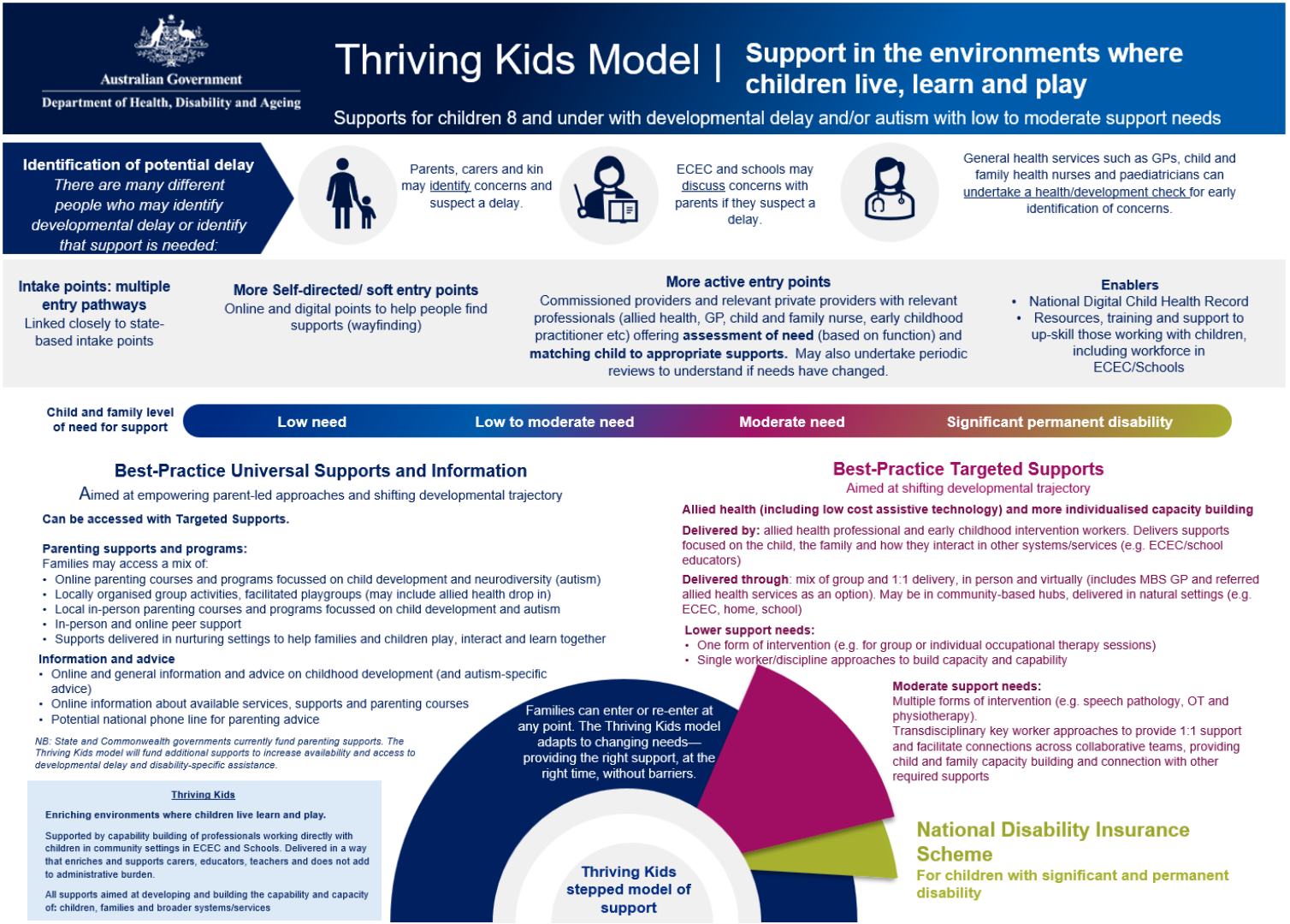
[Model diagram via Thriving Kids Expert Advisory Group. Click to open in new tab.]
Minister Butler’s insights
The Minister emphasised that funding will be channeled through states rather than directly to services, with the first phase starting in October 2026 with full rollout expected by January 2028. He highlighted the critical importance of helping parents support their children, while acknowledging that many families will still require additional professional assistance. Minister Butler indicated that states and territories have agree to some funding structures and it is expected that some funding will flow to states by 20 February.
In the latest press release, Dr Frank Oberklaid commented that the NDIS did not support the needs of children and families. ECIA VIC/TAS welcomes this statement.
You can read the full press release here >>
What we still need to learn
While the announcement lays a strong foundation, several details remain to be clarified, including:
- The health/development check for early identification of concerns.
- How commissioning will work.
Our thoughts
At ECIA VIC/TAS, we know the importance of working in teams to collaborate and provide wrap around supports. A good team makes a big difference.
We are pleased to see the roles of parents/carers as first teachers recognised as integral to the successful delivery of early supports. We are also pleased to see the advisory committee recommending the need for targeted supports aligned with best practice suggesting both individual and group supports. We look forward to seeing the tools and resources as they are developed to support capability and capacity building.
ECIA VIC/TAS looks forward to ongoing collaboration with government, providers, and families to shape the implementation of this model and ensure it meets the diverse needs of our communities.
To read the full article with a detailed breakdown of Stage 3 supports plus key features from an ECI perspective, please consider joining us (your ECI peak body) as a member today. As part of your membership benefits, you'll also gain access to a Thriving Kids hub with the latest updates and downloadable resources.